 Real-IQ
Does Brain Training Work? What Cognitive Science Actually Proves
Discover what neuroscience proves about brain training games, the truth about near vs far transfer, and 3 evidence-based protocols that build real mental stamina.
You download a colorful brain training app on your phone.
You match bright gems on your screen.
You remember patterns of flashing lights and you tap numbers against a fast timer.
After two weeks of daily practice, your score in the app doubles.
You feel much faster while you play.
Then you sit down at your desk to do your real job.
You still lose your train of thought in the middle of a complex report.
You still forget the main points on your weekly task list.
You still freeze when someone asks you a tough question in a live meeting.
Why did your high score in the game not help you at work?
The reason comes down to how your brain wires itself when you practice a new task.
When you understand the science of cognitive transfer, you can tell the difference between real mental conditioning and simple screen entertainment.
The Commercial Promise vs The Stanford Consensus
Commercial brain training grew into a massive industry on one very simple promise that they made to everyone.
App makers claimed that playing simple mini-games for five minutes a day would make you generally smarter in life.
In 2014, more than seventy leading neuroscientists published a joint consensus statement through the Stanford Center on Longevity.
Their conclusion was very clear to everyone who read it.
They showed that there is no solid scientific proof that commercial games raise general intelligence or stop the brain from aging.
Government regulators in the United States later fined major app makers for making false marketing claims.
Even so, showing that commercial hype is false does not mean that your brain cannot change.
It only means that casual mini-games do not give your brain the right kind of challenge for real growth.
Near-Transfer vs Far-Transfer: The Real Line in the Sand
If you want to know what mental practice can do for you, you need to understand two key terms.
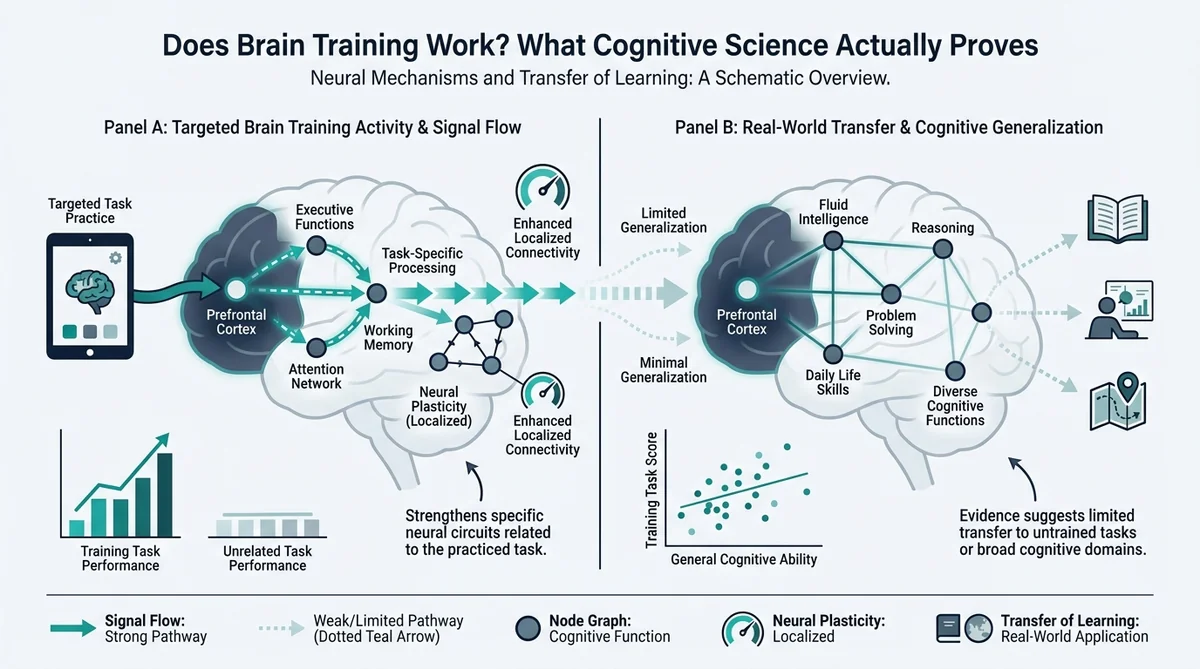
Cognitive scientists split all of these training results into two clear buckets: near-transfer and far-transfer.
1. Near-Transfer: Real, Direct, and Easy to Measure
Near-transfer happens when you practice on one drill and it helps you on other drills that look almost the same.
If you practice remembering lists of numbers each day, your number memory gets better.
If you practice visual search grids, you will find that you can spot hidden shapes much faster than before.
This happens because your brain works hard to strengthen the local circuits that handle that exact routine for you.
Near-transfer is real, and hundreds of studies prove that it works.
2. Far-Transfer: Hard to Find and Rarely Proven
Far-transfer is the claim that when you practice one skill, it will make you much better at totally different tasks in your daily life.
This is the promise that playing a puzzle game will help you plan your money, manage stress, or learn a new language.
When we look at large reviews of all the data, we find that far-transfer effects are actually very weak.
In many cases, they disappear when researchers test players against an active control group.
When a study compares game players against people who do nothing, the players look better just because they expect to improve.
When the other group gets to do a different engaging task, that whole advantage simply goes away.
| Training Method | Transfer Type | Brain Target | Evidence Strength | Real-World Result |
|---|---|---|---|---|
| Commercial Mini-Games | Near-transfer only | Local task habits | Low to Moderate | High game scores with little change in daily work |
| Targeted Cognitive Drills | Strong near-transfer | Prefrontal circuits | High in clinical trials | Better capacity in specific working memory or speed |
| Aerobic Exercise and Sleep | Broad systemic support | BDNF and cell growth | Very high across reviews | Stronger daily attention and general brain health |
| Learning Complex Skills | Broad multi-network transfer | Full brain networks | Very high over time | Flexible problem solving across new situations |
What Long-Term Clinical Studies Actually Show
While casual apps do not work miracles for you, structured mental drills can still give you real benefits when scientists design them with care.
The ACTIVE Study: Real Independence Over Ten Years (2002–2014)
The ACTIVE study is the largest trial of cognitive training that has ever been done with healthy adults.
A team of researchers followed more than 2,800 older adults over ten full years to see how they did.
The participants did ten sessions of focused training in one of three areas: memory tips, logical reasoning, or visual processing speed.
When the trial was over, the results were very clear and impressive.
Eighty-seven percent of the speed group and seventy-four percent of the reasoning group made solid gains.
More importantly, these gains were still there five and ten years later. They helped people keep their driving skills so they could live on their own.
The program worked because it targeted specific operational domains instead of promising a magic boost to general IQ.
Dual N-Back and Working Memory Under Pressure (Jaeggi et al., 2008)
In 2008, Dr. Susanne Jaeggi published a paper claiming that Dual N-Back drills raised fluid intelligence ($Gf$).
Later studies showed that the jump in general IQ was smaller than first reported.
Still, the follow-up research proved an important point.
Dual N-Back drills reliably expand your working memory when you keep the task hard enough.
It will not make you a genius overnight, but it gives you a bigger mental workspace for tough daily tasks.
Brain Biology: Why Most Apps Act Like Slot Machines
Your brain changes its wiring through a process called long-term potentiation.
This physical rewiring needs real mental effort from you, and it needs specific chemical signals in your neurons.
When a task is hard for you, your brain releases acetylcholine and noradrenaline to tell your neurons that they have to adapt.
Most commercial phone apps do the exact opposite of what you need.
They give you bright colors, happy sounds, and easy rewards so that you will keep playing as long as you can.
This triggers a rush of dopamine, but it does not make your prefrontal cortex do heavy lifting.
You end up playing a digital slot machine that tests your reflexes instead of building mental grit.
Real mental training has to feel challenging to you, and it has to adjust to your own personal limit each day.
3 Proven Protocols for Real Mental Conditioning
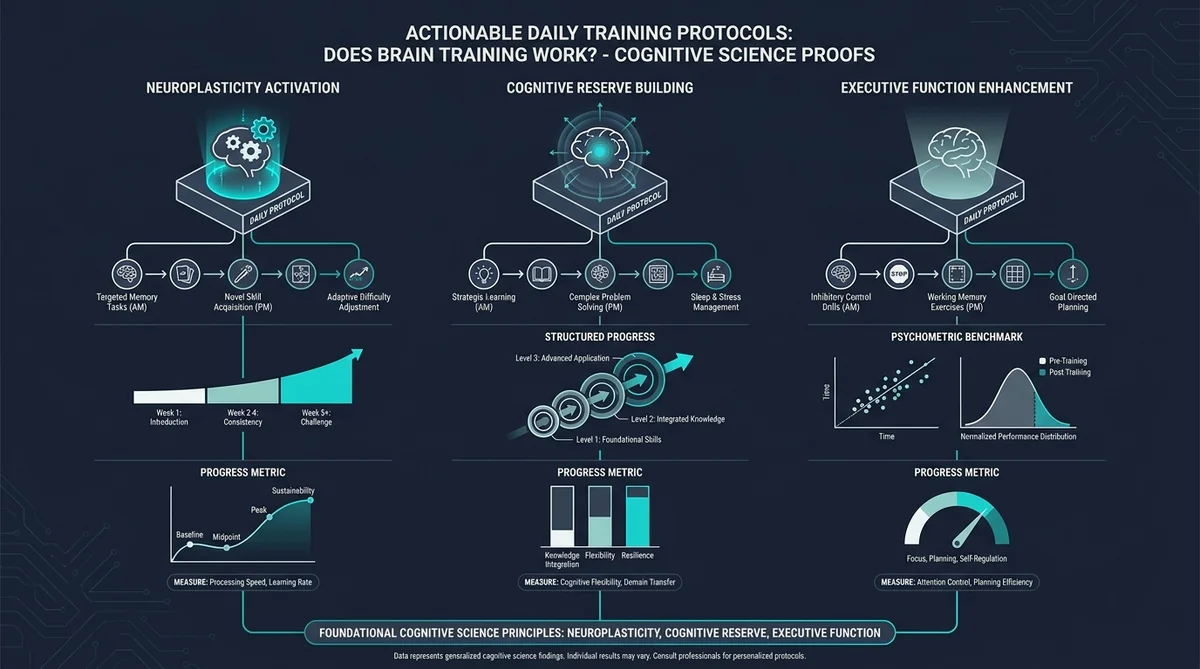
You can use these three research-backed protocols to build specific mental skills that carry over into your daily routine.
Protocol 1: Adaptive Dual N-Back for Mental Capacity
This drill trains your prefrontal cortex so that you can track visual spots and spoken letters at the exact same time.
- The Setup: Use a Dual N-Back app that shows moving squares while speaking letters out loud.
- The Step Up: Start on 2-Back. When you get eighty-five percent correct over twenty rounds, move up to 3-Back right away.
- The Time: Practice four days a week for fifteen minutes in each session.
- The Golden Rule: You must always keep the drill hard enough that you miss a few items, so that your brain has to adapt to it.
Protocol 2: High-Interference Task Switching and SART
This protocol trains your brain to ignore distractions and switch between different rules without slowing down.
- How to do it: Run a SART drill where you press a key for most numbers, but stop yourself whenever you see the number 3.
- Add a twist: Switch between sorting cards by color and sorting them by shape under a strict time limit.
- The Time: Spend ten minutes on this drill three times a week before you start your deep work.
- The Result: This strengthens your ability to stop automatic habits and focus on what matters.
Protocol 3: Cardio Priming Plus Deep Mental Sprints
Physical activity creates the exact biological conditions that your brain needs so that you can learn new things much faster.
- The Physical Part: Do twenty minutes of moderate aerobic cardio to release brain-derived neurotrophic factor (BDNF).
- The Mental Window: Within thirty minutes after your workout, do demanding technical tasks or cognitive processing speed drills.
- The Time: Repeat this pairing three times a week for eight straight weeks.
- The Result: The extra BDNF helps your brain lock in new neural pathways more quickly.
Find Your Real Cognitive Starting Point
Brain training is not a magic shortcut, and it will not solve all your problems by itself.
Even so, working on your specific weak spots can give you real and lasting gains.
Before you start any training at all, you have to find out which of your mental domains needs the most help from you.
A simple puzzle app cannot tell you whether your main bottleneck is in your working memory, your processing speed, or your spatial logic.
You can check your baseline across all five key cognitive areas today.
Get your free 5-area cognitive profile on Real-IQ.
You will see an interactive radar chart with your strengths, your main bottlenecks, and your custom daily plan.
Keep reading
Educational and entertainment content. Nothing here is medical, psychological or employment advice, and no online test is a clinical assessment.