 Real-IQ
Why Your Focus Collapses: Executive Function & Inhibitory Control Protocols
Discover the neuroscience of attentional capture, task-switching costs, and 3 proven executive function protocols to rebuild your focus.
You sit down at your desk to finish an important project.
You open a document, take a breath, and read the first paragraph.
Your phone buzzes once with a social notification.
You glance at the screen for only five seconds.
You put the phone back down and look at your monitor again.
You suddenly find that you cannot remember what you were about to write.
You read the same sentence three times in a row.
Your thoughts feel scattered, and you have to start your reasoning from scratch.
Most people believe that their mental energy is like a fuel tank that empties by the afternoon.
That whole idea is completely wrong.
Your attention does not simply run dry over time.
It is captured by competing stimuli, and the real cost comes from reloading your mental context.
When you understand the neurology of executive function, you can stop attention leaks and protect your deep focus.
The True Cost of a Five-Second Interruption
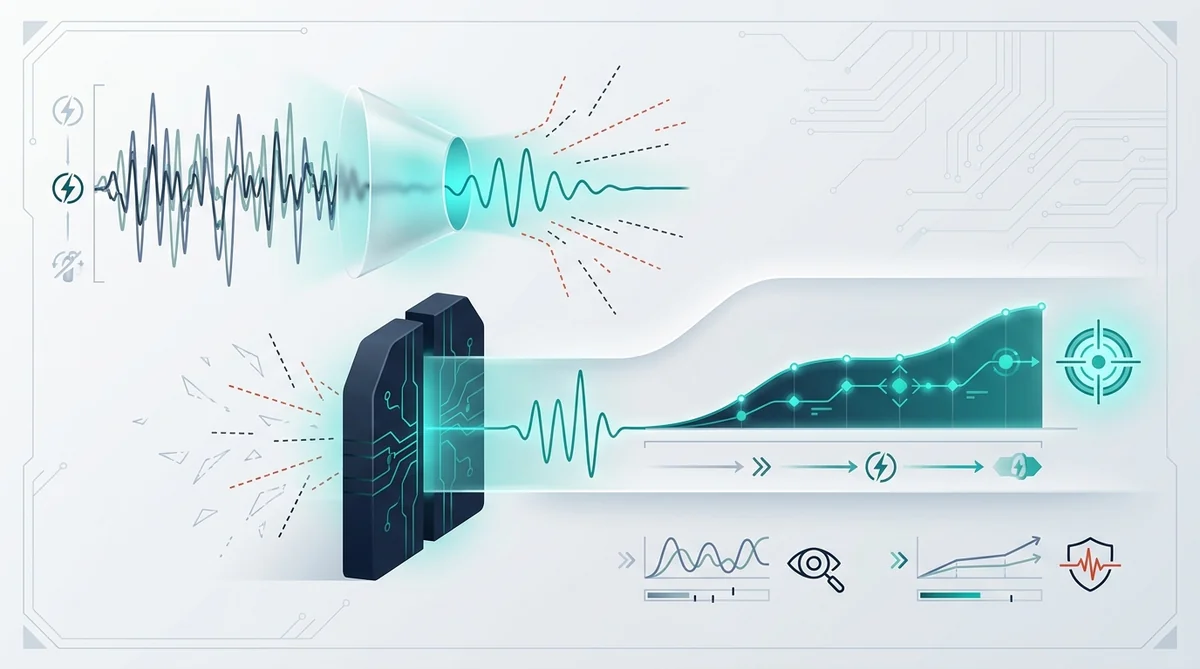
When you switch away from a complex task, your brain has to pay a very steep switching fee for that move.
Psychologists call this the task-switching cost.
When you are working on a demanding problem, your prefrontal cortex loads a full mental model with all your rules, goals, and variables.
A quick glance at an alert on your screen completely flushes that mental model right out of your working memory buffer.
To get back to where you were before, your brain has to rebuild that entire mental state from the page all over again.
In fact, research shows that returning to your deep focus after an interruption can take you up to fifteen full minutes.
And the worst interruptions of all are often the ones that are self-generated by you.
Once you build a habit of checking your phone, your brain starts to generate internal urges without any sound or buzz at all.
And that is why simply putting your phone on silent mode completely fails to solve the real problem.
Because physical distance beats willpower every single time, you really need to keep your phone in another room.
Mind-Wandering is Not a Brain Malfunction
Now, your brain naturally alternates between two major neural networks as you go through your day.
When you concentrate on an external goal, you will see that your task-positive network takes full charge of your mind.
And when you pause for a moment, your default mode network automatically lights up in the background.
The default mode network is responsible for long-term planning, memory consolidation, and creative connections.
So you can see that mind-wandering is just a normal biological cycle rather than a broken system in your head.
Because of this, the goal of focus training is not to eliminate mind-wandering completely from your life.
Instead, the real goal is simply to notice that your mind has wandered off much sooner than you did before.
Scientists call this skill metacognitive monitoring.
In practice, it means catching yourself when you drift after two sentences instead of after two whole pages.
| Attentional State. | Active Brain Circuit. | Main Vulnerability. | Recovery Latency. | Optimization Lever. |
|---|---|---|---|---|
| Deep Flow State. | Dorsolateral Prefrontal & Parietal. | Sensory notification ping. | 15 to 25 minutes. | Total environmental isolation. |
| Fragmented Multitasking. | Superficial anterior cingulate loops. | Constant impulsive task switching. | Zero depth reached. | Single-target time blocks. |
| Default Mind-Wandering. | Medial prefrontal & posterior cingulate. | Loss of current task goals. | 10 to 30 seconds. | Metacognitive self-check cues. |
| Focused Recovery Sprint. | Basal ganglia inhibitory braking. | Fatigue and dopamine depletion. | 5 minutes post-rest. | SART response inhibition drills. |
Inhibitory Control: The Brain's Emergency Brake
When you look at your daily work, your ability to resist distraction depends on a specific executive function called inhibitory control.
Inhibitory control acts as your brain's braking mechanism.
It allows you to stop your automatic impulses, such as when you feel like clicking a new tab or opening an email while reading a report.
This critical braking power lives right in your inferior frontal gyrus and within your basal ganglia circuits.
So when this system gets tired by the end of the day, your resistance drops and you start clicking on every link you see.
Laboratory tests like the Sustained Attention to Response Task (SART) measure how well this brake works under pressure.
In a SART test, you press a button for every number, but you must hold back when you see the number 3.
People with weak inhibitory control press the button anyway because their automatic impulse overrides their conscious goal.
Fortunately, the good news is that you can strengthen this neural brake with deliberate daily practice each morning.
3 Proven Protocols to Rebuild Executive Control
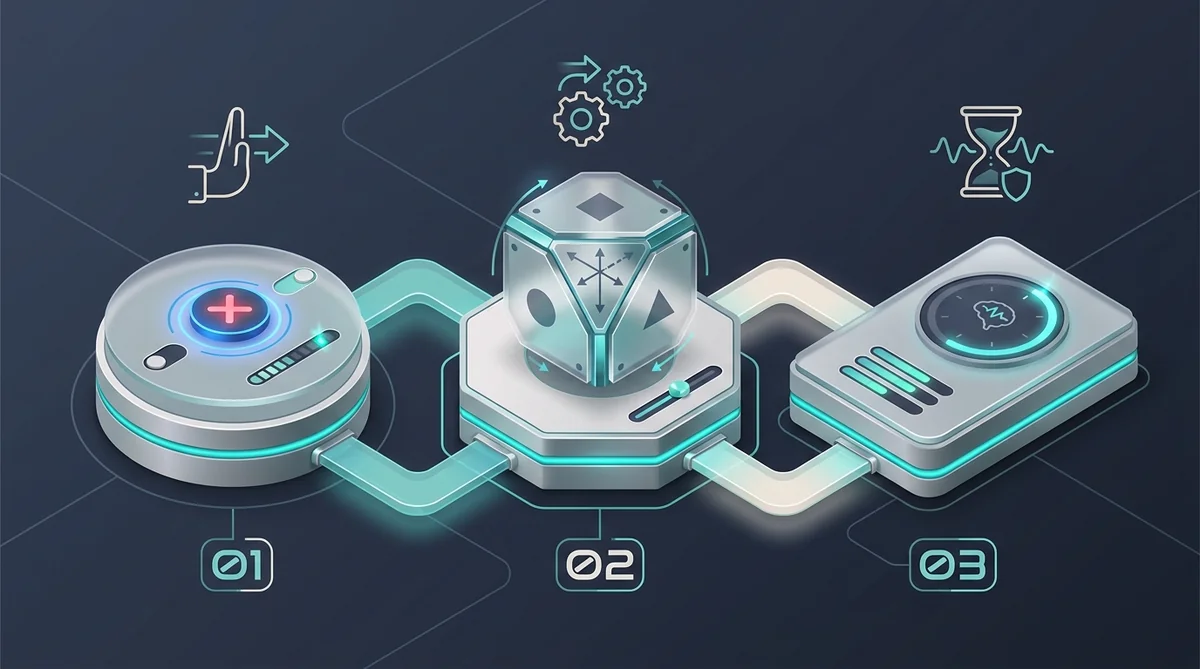
You can use these three evidence-based protocols to restore your concentration and protect your working memory.
Protocol 1: SART Response Suppression Drills
This drill conditions your basal ganglia to stop automatic physical reactions and maintain active vigilance.
- The Setup: Use a digital SART tool that flashes random numbers from 1 to 9 on your screen every second.
- The Rule: Tap the spacebar for every single number, but hold back completely whenever the number 3 appears.
- The Dosage: Complete one session of five minutes each morning before checking messages.
- The Goal: Reduce commission errors to zero while keeping your reaction time steady and fast.
Protocol 2: The Cheap-Return Cognitive Bookmark
This protocol eliminates the painful reload penalty when you take a planned break.
- How to do it: Before you step away from your desk, write down two short sentences on a sticky note.
- What to write: Note exactly what step you just finished and the very next sentence you plan to write.
- The Benefit: When you return, your brain reads the note and reloads your mental context in five seconds instead of fifteen minutes.
- The Routine: Use this bookmark before every lunch, coffee break, or phone call.
Protocol 3: 25-Minute Focus Blocks with Zero-Screen Rest
This protocol builds strong metacognitive monitoring while preventing dopamine burnout.
- The Work Block: Set a timer for twenty-five minutes and work on one single document with all notifications disabled.
- The Physical Break: When the timer rings, take a five-minute break completely away from screens and devices.
- The Cadence: Complete two focus blocks in the morning and two focus blocks in the afternoon.
- The Metric: Measure your day by the number of clean blocks you finish, rather than the total hours you spend at your desk.
Discover Your Full Cognitive Profile
As you can see, attention is just one part of your much broader mental machinery.
Your focus works hand in hand with your working memory and your cognitive processing speed.
If your focus collapses easily during the day, a hidden bottleneck in one of your other cognitive areas may be causing the problem for you.
You can measure your exact performance across all five core intellectual areas today.
Claim your free 5-area cognitive profile on Real-IQ. Start the free test
You will receive an interactive radar chart showing your exact cognitive strengths, your hidden bottlenecks, and your customized training plan.
Keep reading
Educational and entertainment content. Nothing here is medical, psychological or employment advice, and no online test is a clinical assessment.